Configured Commerce Upgrade Watch: September 2026
sts 5.2.2609.386+sts Covers September 2026
Written by Lance Farquhar September 28, 2026
Release 5.2.2609.386+sts, released September 24, 2026. Optimizely's headline this month is multilingual catalog URLs and a Spreedly checkout migration with a hard deadline. The code agrees with both, and it also shows roughly 1,300 lines of Google Pay and agent-checkout machinery that the release notes never mention.
The 30-Second Version
- Headline feature: unified multilingual catalog URLs. A new "Use Home Page Url Segment Across Catalog Pages" setting puts the home page's URL segment in front of catalog, product, brand and search paths, so each language gets one consistent URL tree.
- One breaking change worth checking:
IPathBuilderUtilitiesgained five methods. Low risk, but if you have implemented or decorated that interface, your build will tell you. - One deadline: Spreedly payments move to the Web Checkout SDK. Per Optimizely's notes, Payment Service instances must be on 5.2.2609 or later by December 31, 2026, because Spreedly retires its legacy iFrame in Q1 2027.
- Also shipped: self-service
.well-knownfile hosting, new Content Security Policy controls, keyboard-accessible reordering in the Admin Console, language tags for the top 30 economies, and removal of old SSO Clients code from .NET Core. - Our verdict: a solid, mostly low-drama release. The interesting part is what is in the code and not in the notes: cryptographic Google Pay / AP2 mandate validation and retrying order-status webhooks.
The Headline: One URL Tree Per Language
If you run a multilingual storefront, you have probably fought with catalog URLs. The home page can carry a language-specific segment, while catalog, product, brand and search paths do not, so the same product can end up with inconsistent paths between languages. This release adds a setting, Use Home Page Url Segment Across Catalog Pages, that fixes the inconsistency by prefixing the home page's URL segment to those paths.
The code backs this up. PathBuilderUtilities returns an empty string unless the setting is on. When it is on, the home page URL is resolved per website and language and cached for five minutes. The existing catalog and product root-path getters were refactored into "without home page segment" helpers that the public getters wrap, so the prefix is applied in one place.
The breaking change Optimizely lists is real, and it is the five new methods on IPathBuilderUtilities:
// IPathBuilderUtilities.cs (new members, signatures only)
string GetHomePageUrlSegment(ILanguage? language = null);
string CombineWithHomePageUrlSegment(string rootPath, ILanguage? language = null);
string RemoveHomePageUrlSegment(string path, ILanguage? language = null);
string RemoveHomePageUrlSegmentForAnyLanguage(string path);
string RemoveLeadingContext(string path);
RemoveHomePageUrlSegmentForAnyLanguage is the one that shows the engineering was done carefully. Its doc comment explains the case it exists for: when a shopper switches languages, the incoming URL can still contain the previous language's home page segment while the active language context has already changed. Stripping only the current language's segment would leave the old one in the path. If you use a custom IPathBuilderUtilities, add all five.
Two related pieces are worth knowing. CatalogPathBuilder threads an includeHomePageUrlSegment option through its overloads, and a newer sibling, CatalogPathBuilder2, takes a pre-loaded dictionary of translated product URL segments so code that builds many product URLs does not make one translation lookup per product. We confirmed the class and its shape. We did not trace every caller, so we are not claiming where it is used.
What Else Shipped
Spreedly Web Checkout SDK. Both the back end (SpreedlyUtilities) and the front end (useSpreedlyFrame.ts) now pin SDK version 1.5.1 and load it with the same Subresource Integrity hash, and a unit test fails if the two drift apart. The deadline is the part to put on a calendar: Optimizely's notes say Payment Service instances must be on 5.2.2609 or later by December 31, 2026. If you run a separate Payment Service, schedule that upgrade, not just the storefront.
Self-service .well-known hosting. WellKnownController now serves any file uploaded to /userfiles/_system/.well-known, which is what you need for domain-verification files without a support ticket. It rejects paths containing .. or rooted paths and sets the content type from the file name. The Apple Pay domain-verification and UCP profile routes stay as they were.
Content Security Policy controls. The security headers settings group already existed, so this is an extension of it, not a new feature area. The default policy is now object-src 'none'; base-uri 'self', there is a separate Admin policy, and there are report-only variants for storefront and Admin so you can watch what a policy would block before enforcing it. frame-ancestors 'self' is added automatically except for punch-out sessions, so a stricter default does not break procurement iframes.
Keyboard-accessible reordering. New Admin Console reorder components use @dnd-kit with both a pointer sensor and a keyboard sensor and announce moves to screen readers. A small change on paper and a real accessibility fix for content editors.
Language tags for the top 30 economies arrive through a database script and updated language repository code, and the deprecated SSO Clients code was removed from .NET Core (the .NET Framework files remain). Optimizely's notes also list Search v3 failover to Elasticsearch, a CMS Type editing restriction, and Cloudflare visitor-location headers. The Search v3 failover is real, but it is not in this release's diff: it shipped earlier in hotfix builds and is confirmed in our September LTS post. We did not trace the other two, so treat them as "per the release notes."
What We Actually Found: Google Pay and Agent Checkout, Built in Silence
Optimizely's September notes do not mention UCP, the Unified Commerce Platform integration behind Google Pay and AP2 agent-initiated checkout. The code does. August shipped only the settings foundation. September adds six new back-end files and about 1,300 lines on top of it, plus two new CustomerOrder columns (UcpCanceledOn and UcpSessionStartedAt) with database scripts to match.
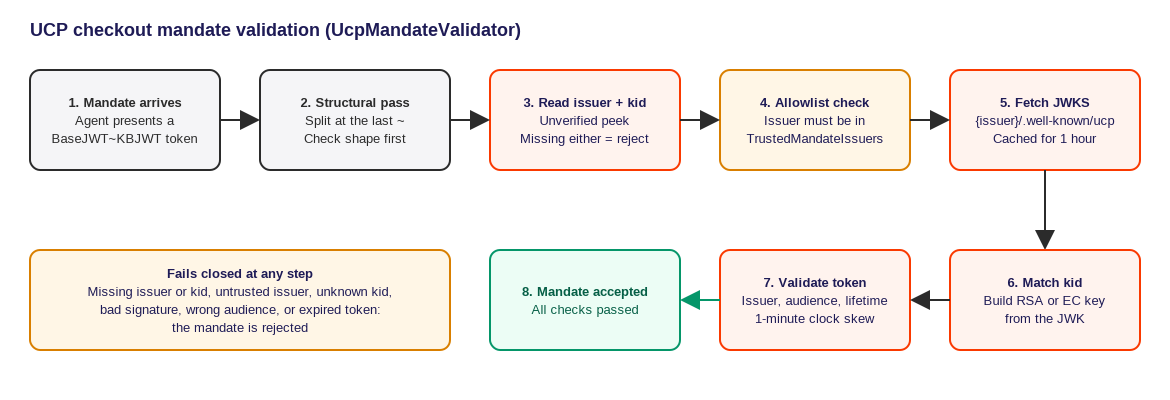
The centerpiece, UcpMandateValidator, checks the "checkout mandate" a shopper's agent presents. That is a compound BaseJWT~KBJWT token, and the validator does real cryptographic work. It reads the issuer and key ID without trusting them, rejects the token if either is missing, requires the issuer to be on a TrustedMandateIssuers allowlist, then fetches the issuer's signing keys from {issuer}/.well-known/ucp (cached for an hour), builds an RSA or EC key from the matching entry, and validates issuer, audience and lifetime with a one-minute clock skew. Anything that fails is rejected. That is the right shape for something that authorizes a payment on a person's behalf.
The outbound side is just as deliberate. UcpOrderStatusService tells the partner when an order's status changes, mapping internal statuses to UCP's (Complete becomes Fulfilled, Void becomes Cancelled, and statuses with no equivalent are simply not reported). It retries up to four times with exponential backoff and random jitter, honors a server's Retry-After header up to 30 seconds, retries 429 and 5xx responses, and treats other 4xx responses as permanent. The two handlers that trigger it defer the send until the database transaction commits and swallow their own failures, so a webhook problem can never fail the order. That is the part most integrations get wrong.
A second find sits in the Spreedly migration. In the front-end hook, a flag named useSdkAchTokenization is hard-coded to false. The comment explains why: in SDK 1.5.1, ACH (bank account) tokenization posts to an endpoint that returns no CORS headers, so it fails in the browser, and a support ticket is open with Spreedly. Until that is fixed, ACH tokenizes against Spreedly's older, CORS-enabled endpoint instead. Both code paths are implemented behind the one flag. If you take bank payments through Spreedly, test ACH specifically before your cutover, and ask Optimizely or Spreedly where that ticket stands.
We can confirm all of this exists in the source. We cannot tell you from the code alone how complete the Google Pay story is end to end, or when Optimizely plans to announce it, so if UCP matters to you, ask your Optimizely contact directly.
Under the Hood
WebMCP tools learned about maintenance mode. August's seven storefront tools now call a new assertNotInMaintenanceMode guard. During a maintenance window an agent gets a clear, non-retryable error telling it to tell the user to try later, instead of whatever a half-up storefront would return.
Nightly Maintenance changed again, and it is UCP-shaped. A new sweep converts orders stuck in PendingPaymentValidation to abandoned carts, but only when the order number is still a GUID placeholder. A real order number means 3DS or BNPL validation genuinely began, so those are left alone however old they get. The abandoned-cart purge also keeps a canceled UCP session for one extra day before deletion.
A mechanical sweep explains most of the file count. Both diffs touch roughly 230 to 280 files because of a new custom ESLint rule that replaces React.xyz namespace access with named imports. It is autofix cleanup, not a feature, so do not let the raw diff size alarm your reviewers.
What This Means for You
- Business stakeholders: if you sell in more than one language, the unified catalog URL setting is worth a conversation with your SEO owner before you enable it, because it changes the URLs search engines see. If you take payments through Spreedly, the December 31, 2026 Payment Service deadline is a real date.
- Developers and architects: add the five
IPathBuilderUtilitiesmethods if you implement or wrap it, and plan to test redirects for existing catalog URLs after turning the setting on. Test Spreedly checkout and ACH on a non-production environment first. - Security and compliance owners: start with the report-only CSP settings to see what the new defaults would block, and note that
.well-knownuploads are now self-service. - Anyone evaluating Google Pay or agent-led checkout: the code is real and carefully built, but it is not in the release notes, so get Optimizely's current position in writing before you plan around it.
Planning a September upgrade, a Spreedly cutover, or a multilingual URL cleanup and want a second set of eyes on what actually changed under the release? That is exactly the kind of review Nishtech does for clients every month, so reach out and we'll walk through it with you.