Configured Commerce Upgrade Watch: October 2026
sts 5.2.2610.481+sts Covers October 2026
Written by Lance Farquhar October 26, 2026
Release 5.2.2610.481+sts, released October 22, 2026. This is a security release in everything but name: storefront account hardening, PunchOut fixes, and a startup check that will stop some deployments from booting until they set a secret. We read the code behind each claim, and in a few places the code is more candid than the release notes.
The 30-Second Version
- Headline: stronger storefront account protection. Password reset is now rate limited, the Remember Me cookie is signed and tied to the website, and Optimizely lists several account and API access fixes on top.
- The upgrade note that matters most: if no
SpireClientSecretis configured outside development, the application now refuses to start. The old default secret was identical on every deployment. - PunchOut: credential validation now runs before session and order processing, a new "Allow PunchOut in an iframe" setting supports procurement systems that embed your storefront, and the breaking change is MEDIUM risk if you have customized the credential handlers.
- Also shipped: an Export All option for order and invoice history, non-root containers, faster web fonts, and a 30 MB default cap on Storefront API request bodies.
- Our verdict: a release worth prioritizing if you are several versions behind. Plan for a one-time re-sign-in for remembered users and a required secret before you schedule it.
The Headline: Hardening the Storefront Account
Most of this release's value sits in the code paths that handle who a shopper is. Three pieces stand out, and we confirmed each one in source.
Password reset got rate limiting and optional reCAPTCHA. New settings on the security group give you a rate limiter that is on by default: a 15-minute window, 100 failures per IP address and 10 failures per user. Separate toggles add reCAPTCHA to the reset-password submit on the client side and, optionally, on the server side. Both reCAPTCHA toggles default to off, so turning them on is your decision.
Remember Me is now a signed, self-contained cookie. The new RememberedUserCookie carries the user id, the website id and the issue time, covered by a certificate-based signature with its own expiry. When a request arrives, the signature and expiry are verified before any field is trusted. The code comment is blunt that the old scheme was something else (it mentions "an old DES cookie") and that values not matching the new scheme are rejected. Revocation works through a new RememberMeInvalidatedOn column on the user profile, so a user's remembered sessions can be invalidated without a server-side token store (we did not trace what sets that stamp). The practical consequence is in the upgrade notes: remembered users must sign in again once.
The access-token handoff was tightened. The front-end server only honors a token posted to it when the request's Origin matches your site and the visitor does not already have an authenticated session, and attempts are rate limited per source address (10 per minute). Every refusal is logged under one searchable prefix, AccessTokenHandoffRejected, so you can alert on it. If an integration or mobile app posted tokens from another site, it has to use the Authorization header on /RedirectTo/MobileAuth/ instead.
Optimizely's notes also describe fixes such as buyers being unable to remove their own role through the Account API without approval, guests being unable to list saved cards, and deactivated users losing token access immediately. Those handlers changed in the diff, but we did not trace each one individually, so we are reporting them as "per the release notes."
What Else Shipped
PunchOut. Credential validation moved from Order 700 or 800 to Order 550 in the setup, order request and profile transaction handlers, and credentials are now read through a new GetRequestCredentials pipeline. This is the notes' MEDIUM-risk breaking change: if you replaced or reordered a credential handler, review it. The new Allow PunchOut in an iframe setting changes cookies written during a PunchOut session over HTTPS to SameSite=None; Secure so a session survives inside a procurement system's frame. Read its description before enabling it: PunchOut requests are served without X-Frame-Options and without an automatic frame-ancestors, so you must add a frame-ancestors directive naming the procurement system yourself, or the framed session is exposed to clickjacking.
Export All. Order History and Invoice History can export the full result set to CSV, and the export now escapes cells that begin with a formula character so a spreadsheet will not execute them.
Request size limit. A new setting caps Storefront API request bodies, defaulting to 30 MB and applying to /api/ paths other than the admin and internal ones.
Containers. The Dockerfiles for the Admin, Storefront and Integration APIs, the database updater and the front-end image now switch to a non-root user.
Type changes. DependencyExclude was replaced by DependencyExcludeAttribute, and IBusinessObject.SetProperty and GetProperty are marked obsolete with the message "extend the schema if you need a new property," in debug builds only. Optimizely's notes list these as low risk. A hotfix on October 23, 5.2.2610.487, only updates Node.js to 22.23.4.
Not traced. The notes also list faster web fonts, file-upload type restrictions (blocking .xml, .html, .js and .css), masked system settings no longer sent to the browser, and the SSO rule that links first-time sign-ins only when the identity provider confirms the email. We saw the SSO setting exist in the code, but we did not read the other items, so treat them as the notes' claims.
What We Actually Found
The default Spire client secret was the same everywhere. The new SpireClientSecretResolver is the most important code in the release. When no SpireClientSecret is configured, it now throws at startup outside development, and its message says the default secret "is identical on every deployment and grants full admin API access." You can still choose to accept the risk by setting an environment variable named ACCEPT_RISKS_OF_USING_DEFAULT_SPIRE_CLIENT_SECRET to true, but the name tells you what you are agreeing to. If you have ever stood up an environment without setting that secret, treat this as more than a deployment annoyance: check every environment, including old test and staging instances.
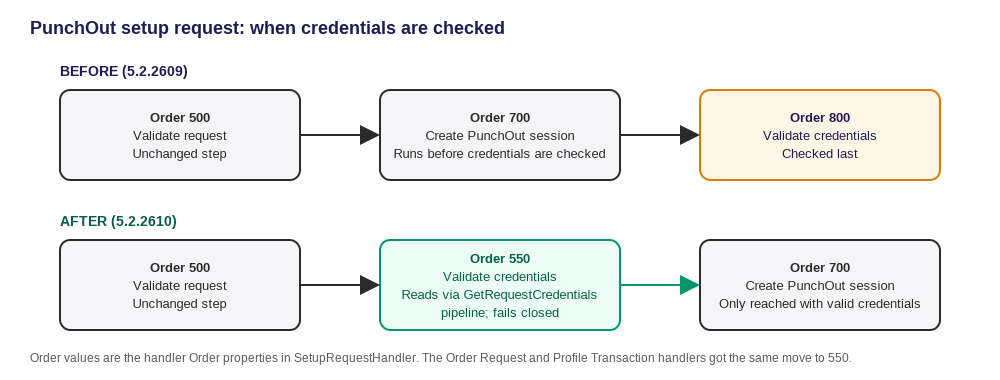
PunchOut used to validate credentials after it started work. In the previous release, the setup handler created the PunchOut session at Order 700 and checked credentials at Order 800. The order request handler had the same shape, with creation at 600 and validation at 700. Both now validate first, at 550, and fail closed with a generic message. We can confirm the ordering change; we did not determine whether the old order allowed anything to persist before a bad request was rejected, so we are not claiming it did.
Optimizely's own code comment admits a remaining gap. In the access-token handoff, the comment says the query-string path is "the weaker of the two": a guest or anonymous visitor who follows a link carrying someone else's token is still signed in as that token's owner. Fixing that would need proof that the visitor started the sign-in, which the callers building those links do not provide today, and a server-issued nonce was considered and not adopted. It is good engineering to write that down. It also means that if you send sign-in links by email or message, you should know which path they use, and prefer the Authorization header where you control the client.
Two smaller observations: a new database script adds a role named PunchOutHub, which the release notes as we read them do not mention, and we did not trace what it gates. And the rate-limit defaults (100 failures per IP, 10 per user) are generous for a single address behind a shared proxy, so consider whether your traffic arrives with real client addresses.
Under the Hood
The Remember Me design is better than it needs to be. Because the signature carries its own expiry and the cookie needs no server-side store, verification is cheap, and the per-user invalidation stamp gives you revocation without a lookup table. The integration tests added with it include a forgery test and two expiry tests, which is the right set.
Rate limiting runs before work, in the right order. In the token handoff, the origin check happens before the rate limit, so a hostile page that makes a visitor's browser submit forms cannot use up that visitor's allowance.
Most of the file count is not a feature. The backend diff touches about 1,000 files and tens of thousands of lines, but a large share is tests and mechanical change. The security work above is a small, focused core.
What This Means for You
- Business stakeholders: if you have PunchOut customers, ask whether any of them embeds your storefront in a frame; the new iframe setting exists for them but needs a matching security configuration. Warn customer service that remembered users will need to sign in once after the upgrade.
- Developers and architects: set
SpireClientSecretin every environment before upgrading, review any custom PunchOut credential handlers, and move any cross-site token posting to the Authorization header. Check forIBusinessObject.SetPropertyandGetPropertyusage in a debug build. - Security and operations: decide whether to enable the reCAPTCHA toggles on password reset, add an alert on
AccessTokenHandoffRejected, and confirm your Docker base images and volume permissions work with the non-root user. - If you are several releases behind: this release is where much of the account-hardening work lands, so it is a good target for a security-driven upgrade.
Planning an upgrade to 5.2.2610 and want help checking secrets, PunchOut handlers and cookie behavior before you cut over? That is exactly the kind of review Nishtech does for clients every month, so reach out and we'll walk through it with you.