What's New and What's Next for Optimizely Commerce Connect
Written by Lance Farquhar October 2026
Optimizely used its September 2026 "What's New, What's Next" webinar to answer a question a lot of Commerce Connect customers have been quietly asking: is Optimizely still investing in commerce? The answer from product leadership was a direct yes — backed by a dedicated engineering team, a named senior product manager, and a roadmap built almost entirely around agents working inside the catalog, pricing, and order workflows teams already touch every day. Here's what's actually shipped, what's landing this month, and what we think is worth planning around now.
The 30-Second Version
- Optimizely answered the "are you still investing" question directly — a dedicated engineering team, a named senior product manager (Shahrukh Ikhtear), and a roadmap organized around three themes: agentic commerce, workflow efficiency, and built to build on.
- The biggest release to date is Commerce V15, shipped alongside CMS 13, plus a steady run of smaller merchandiser and marketer features — compliance-driven pricing display, ODP custom fields, Graph-powered search, bulk catalog translation, and a revamped catalog UI.
- Three features are targeted for this month: Mark AI (the renamed Opal agent platform) reading order and pricing data to answer support questions, a Product Auditing Agent that checks your catalog against rules you supply, and a Google-powered semantic search service.
- Q4's centerpiece is Commerce Event Plus — an event bus that lets agents react to catalog changes as they happen, aimed squarely at the "we caught this gap after it was already live" problem.
- Read the roadmap as a direction, not a delivery date. Optimizely said so itself: roadmap items are current thinking, not commitments, and the speaker's own release timeline in the session was loose.
Why Commerce Is Being Rebuilt Around Agents
The framing for all of this is a shift in where shopping actually starts. Buyers increasingly open ChatGPT, Gemini, or another AI assistant before they open a search engine or a retailer's own site. Ikhtear offered a personal example: he bought a paddle racket after asking Gemini to explain weight balance and materials, and it pointed him to a UK merchant he'd never have found otherwise. The session also cited a McKinsey estimate that up to $1 trillion of US retail could flow through agents by 2030 — directional, not a number to build a business case on by itself, but it explains why Optimizely is pointing its roadmap where it is.
That shift reshapes how Optimizely talks about its own platform. Commerce is framed as content — a building block both human shoppers and AI agents interact with, sitting alongside experience creation (CMS, assets, commerce), experience optimization (experimentation, personalization, feature management), and an agent platform now rebranded Mark AI (formerly Opal) that supplies virtual teammates, skills, and context.
What customers are actually asking for, per the session, is refreshingly unglamorous:
- Speed to launch — products and promotions live in minutes, not days or weeks
- Clean, structured catalogs that agents and ERP/integration jobs can rely on, with gaps caught before publishing rather than after
- Visibility in AI-driven search and shopping, not just traditional search
- AI inside the workflows teams already use, rather than a parallel set of new ones
- Smoother upgrades
That last one matters more than it sounds like it should, and we'll come back to it.
What's Already Shipped
| Period | Release | What it does |
|---|---|---|
| May – September | Commerce V15 (with CMS 13) | New AI-ready commerce platform |
| May – September | Lowest price in last 30 days | Shows a product's lowest price over the prior 30 days when it's on promotion — a compliance feature, not a merchandising one |
| May – September | ODP custom field support | Custom fields now supported with Optimizely Data Platform |
| May – September | Graph Commerce Search provider | Graph-powered search available as a provider |
| Across the period | Revenue per visitor / cart abandonment stats | Front-end performance metrics added to reporting |
| Across the period | Product catalog translation service | Bulk-translate products and publish them to the store |
| April | Revamped product creation workflow | Now the default catalog management flow — one window, less tab-switching, better performance |
| Q1 | Customizable views | Save and share catalog views, e.g. by brand or category |
| Q1 | Dynamic package enhancements | Bundle prices adjust automatically as products and variants are added or removed |
Nothing here is speculative — this is the list of what's already in customers' hands. It's worth noticing that most of it is unglamorous catalog-management plumbing, not AI features. That's not a knock; it's the foundation the agentic roadmap below is actually being built on top of.
The Roadmap: Three Themes, Three Features Due This Month
Optimizely organized the roadmap around three themes. Agentic commerce puts Mark AI tools directly inside everyday catalog, promotion, and order-management work — adding a batch of products to a category or enabling them for a market in seconds instead of manually. Workflow efficiency means better tool and API support so those agents can work with less human babysitting. Built to build on protects the extensibility and tight CMS integration customers already rely on — API endpoints, smoother upgrade and migration tooling, and more relevant Graph search.
Three features were called out as targeted for September, the month of the webinar:
- AI tools for orders and pricing. Mark AI reads order and pricing data to answer questions in context — a support agent could ask for every order from a named customer instead of searching manually.
- Product Auditing Agent. Built with input from Optimizely's Customer Advisory Board, it checks catalog data against rules you supply — the session mentioned SOC 2, FSMA 2.0, and GDPR as example inputs, typically a PDF of your own regulations. It flags missing attributes and non-compliant descriptions, recommends fixes, and offers a button to apply them, keeping a person in the loop rather than auto-publishing.
- Google Search Service. Built on Graph-powered search and Vertex AI, aimed at natural-language queries that keyword search handles badly — "tents that are perfect for six people in a rainy season" was the example given — with a self-learning relevance algorithm.
Q4: The Vision, Step by Step
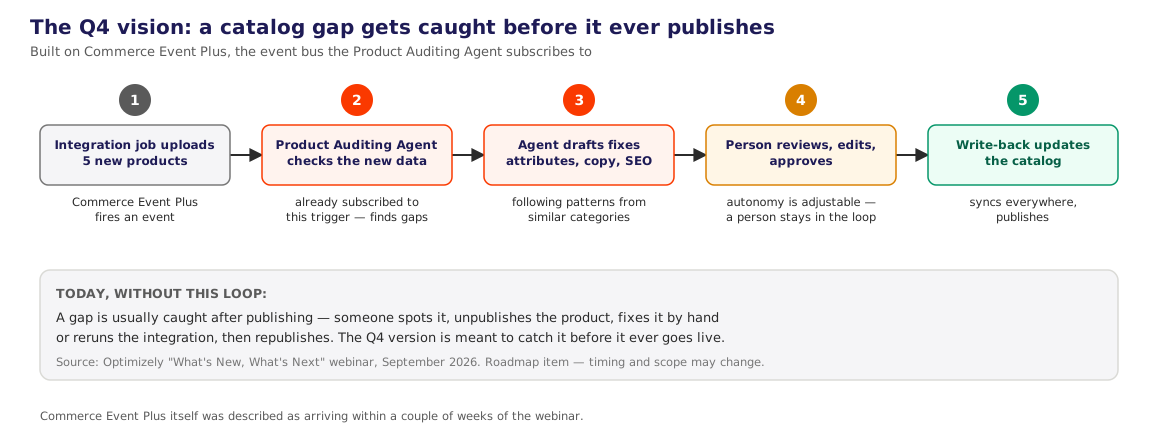
Q4 extends each theme rather than introducing new ones. Under agentic commerce, expect more bulk catalog tools: adding attributes across products, placing products in categories, adding products to bundles. Under workflow efficiency, expect built-in buttons directly in the catalog management screens that surface products with missing attributes and let you fix them yourself or hand them to the agent. Under built to build on, Optimizely plans to expose the product catalog to LLM providers through standards like UCP and ACP, plus a scheduled product-catalog feed that LLM shopping tools can consume.
The clearest picture of where this is headed is the workflow above, built on Commerce Event Plus — an event bus that logs catalog activity (updates, new products, attribute changes, new promotions, placed orders) and exposes it as webhooks the agent platform can subscribe to. An integration job uploads new products, the event fires, the Product Auditing Agent (already subscribed) checks the new data and finds gaps, drafts fixes, a person reviews and approves, and the write-back publishes everywhere. Commerce Event Plus itself was described as arriving within a couple of weeks of the webinar — closer than the rest of Q4.
The speaker was explicit that autonomy here is a dial, not a switch: as a team gets comfortable with Mark AI acting in the back end, they choose how much freedom to give it. Nothing about this forces a team straight to full automation.
What's Solid vs. What's Still a Slide
Here's our honest read, separate from how Optimizely itself framed it. Everything in the "What's Already Shipped" table is real — dated, shipped, and checkable against your own instance today. Everything from "three features due this month" onward is a different category of claim, and it's worth keeping the two apart when you're setting expectations with your own stakeholders.
The September features were described as targeted for September, not confirmed shipped as of the session — and the speaker's own timeline through the "already shipped" recap was, in the session's own framing, loose rather than precise. That's not a criticism of the roadmap; it's Optimizely being straightforward about its own uncertainty, and it's worth taking them at their word rather than reading "targeted for September" as "shipped in September."
The Q4 items carry Optimizely's own explicit caveat — current thinking, not commitments, timing and scope may change — and that caveat deserves to be repeated to anyone on your team who hears "Commerce Event Plus" and starts planning a Q4 integration around it as though a ship date were fixed. The session also included a candid admission that the Commerce 13-to-14 upgrade was painful because it was a full framework rewrite, with a promise that 14-to-15 migration tooling will cut that time down. That promise is itself unproven until teams actually run it — worth factoring into any upgrade plan rather than assuming it on faith.
None of this is a reason to discount the roadmap. It's a reason to plan your own work in two separate buckets: what you can act on today (the shipped list, and cleaning up your catalog data regardless of what ships next), and what you should watch for before committing resources against it (everything still described as targeted or planned).
What This Means for You
- If you're a business stakeholder, the prerequisite for every item on this roadmap is the same: clean, structured catalog data. The Product Auditing Agent works from rules you supply, and every agent feature downstream of it assumes attributes and descriptions are already in reasonable shape. That work doesn't wait for Q4 — it can start now.
- If you own catalog operations, decide your comfort level with automation before the tooling forces the question. Start with agents that suggest fixes for a human to approve, and widen autonomy only as trust builds — that's literally how Optimizely described the dial working.
- If you're a developer or architect, watch for Commerce Event Plus and the UCP/ACP protocol work specifically — that's the part of this roadmap with real integration implications. And budget your 14-to-15 upgrade plan on the assumption the streamlining is real but unverified until your own migration proves it, not on the promise alone.
- If you want in on where this goes next, Optimizely's Customer Advisory Board gives members early access and a say in priorities (worth asking your Optimizely rep about the waitlist), and a new commerce-specific user community is live now through the Admin Center in Opti ID. Opticon London is October 13, with the Commerce Connect team doing demos of this exact roadmap.
Trying to figure out what "clean up your catalog data" actually means for your specific implementation, or want a read on which of these roadmap items are worth planning around for your upgrade timeline? That's exactly the kind of assessment Nishtech does for clients — reach out and we'll help you sort the shipped from the slideware.
-
 Optimizely, Ecommerce, Technology
Configured Commerce Upgrade Watch
Read More
Optimizely, Ecommerce, Technology
Configured Commerce Upgrade Watch
Read More
-
 Optimizely, Ecommerce, Technology
Classic to Spire: What Migrating Your Configured Commerce CMS Actually Takes
Read More
Optimizely, Ecommerce, Technology
Classic to Spire: What Migrating Your Configured Commerce CMS Actually Takes
Read More
-
 Optimizely, Ecommerce, Technology
Running Your Configured Commerce APIs on Linux: What It Actually Takes
Read More
Optimizely, Ecommerce, Technology
Running Your Configured Commerce APIs on Linux: What It Actually Takes
Read More
-
 Digital Strategy, Optimizely, Technology, Ecommerce
Why Nishtech Is Betting on Optimizely, Shopify+ & Znode for 2026 and Beyond
Read More
Digital Strategy, Optimizely, Technology, Ecommerce
Why Nishtech Is Betting on Optimizely, Shopify+ & Znode for 2026 and Beyond
Read More